
- Federal
- DOT · Federal
- Urine
- At-home rapid test
What Does a Preliminary Positive Mean?
Short answer
It means a screening test flagged your sample, and it now needs a confirmatory test. Nothing has been established. The screening stage reacts to a family of similar compounds, so a flag is a prompt for more specific analysis rather than a finding. In a regulated program, confirmation happens automatically, and a physician reviews the outcome before your employer is told anything.
What matters most
- A preliminary positive is a flag for further testing, not a result.
- Screening methods react to classes of similar compounds, which is why confirmation exists.
- In regulated testing, confirmation and physician review happen automatically.
- A confirmatory test can and often does come back negative.
- Nothing is reported to an employer until the review stage is complete.
Jump to section
How the process runs
- Screen flags the sample
An initial test reads at or above the screening cutoff. At this point nothing has been identified specifically.
- Confirmatory analysis
A more specific method identifies the individual compound and measures it against a lower confirmatory cutoff.
- Physician review
Where a confirmed positive is reported, a Medical Review Officer checks the paperwork and contacts you about any lawful explanation.
- Verified outcome
Only now does a result exist to be reported — and it may be negative, positive or cancelled.
What this means for you
Rules differ by state and employer. This section describes federal requirements. Your state law or your employer’s written policy may add rules on top of them.
When the answer changes

Dr. Matthew Nuesse
DOT Certified Medical Examiner
Dr. Matthew Nuesse is a DOT Certified Medical Examiner who reviews Exploro's drug testing guides for medical and procedural accuracy.
Common questions
Is a positive screening result final?
No. A sample that screens positive goes on to a second, more specific confirmatory test, and the result is then reviewed by a Medical Review Officer. The MRO must give you the chance to explain a legitimate medical reason before reporting the result to your employer.
Can I have the sample tested again?
Yes. Every DOT collection splits your sample into two bottles. If the Medical Review Officer reports a positive, refusal, adulterated or substituted result, you have 72 hours from being told to request that the second bottle be tested at a different certified laboratory. The MRO has to tell you about this right.
My home test and the laboratory disagreed. Which one is right?
The laboratory. A home test is a screening device set to its own cutoff, and the FDA describes consumer tests as qualitative — they suggest whether a substance may be present, not how much. Laboratory testing is the reliable way to confirm a result.
Official sources
Every factual claim above is drawn from these sources. Each was opened and checked on the date shown. Where a rule differs between agencies, the source that governs is named in the text.
-
DOT ODAPC · 49 CFR Part 40 (ODAPC)
49 CFR Part 40 — section navigator and Q&As
View official source ↗ (opens in a new tab) -
eCFR · 49 CFR Part 40 (eCFR)
49 CFR Part 40 — Procedures for Transportation Workplace Drug and Alcohol Testing Programs
View official source ↗ (opens in a new tab) -
DOT ODAPC · DOT §40.85
49 CFR §40.85 — What are the drug test cutoff concentrations?
View official source ↗ (opens in a new tab)
From Exploro
Check a result at home first
A home test is a screening step. It tells you whether a substance is above or below that test’s cutoff — not how much, and not what a laboratory would report.
-
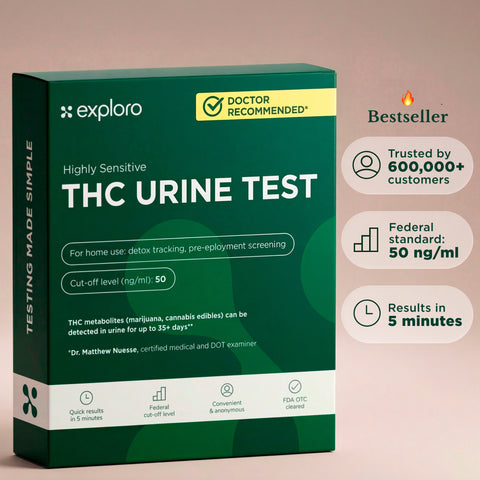 THC Urine Drug Test, 50 ng/mL, 15 StripsReads at 50 ng/mL — the federal screening cutoffThe same cutoff most US workplace urine screens use. Two lines means below the cutoff, one line means above it — and fifteen strips means you can retest as the date gets closer.
$13.49
See details →
THC Urine Drug Test, 50 ng/mL, 15 StripsReads at 50 ng/mL — the federal screening cutoffThe same cutoff most US workplace urine screens use. Two lines means below the cutoff, one line means above it — and fifteen strips means you can retest as the date gets closer.
$13.49
See details →
-
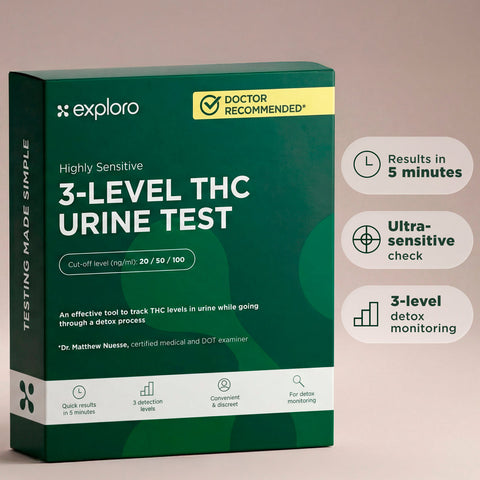 3-Level THC Urine Drug Test, 5 Dip CardsReads at 20, 50 and 100 ng/mLThree cutoff levels on one dip card instead of a single pass-or-fail line, so you can see which way the number is moving rather than only whether you are over it.
$14.99
See details →
3-Level THC Urine Drug Test, 5 Dip CardsReads at 20, 50 and 100 ng/mLThree cutoff levels on one dip card instead of a single pass-or-fail line, so you can see which way the number is moving rather than only whether you are over it.
$14.99
See details →
-
 THC Detox Liver Cleanse, 60 CapsulesNatural ingredients · Doctor-developed · Made in USADoctor-developed formula with natural ingredients designed to support toxin elimination. Made in the USA.
$33.99
See details →
THC Detox Liver Cleanse, 60 CapsulesNatural ingredients · Doctor-developed · Made in USADoctor-developed formula with natural ingredients designed to support toxin elimination. Made in the USA.
$33.99
See details →

Exploro makes these tests. Star ratings are from Amazon customer reviews and are refreshed periodically; current prices and full instructions are on each product page.

