
- Federal
- DOT · Federal
- Urine
- Lab confirmation
Negative, Dilute, and Invalid Results Explained
Short answer
Beyond positive and negative, there are several outcomes. Dilute means the sample was watery enough to weaken detection. Adulterated or substituted means the sample was interfered with or was not urine. Invalid means the laboratory could not get a usable result. Cancelled means the test does not count as a result at all. Each has its own consequence, and some are treated as seriously as a positive.
What matters most
- A drug test has more than two possible outcomes.
- Dilute is about the sample's concentration, not about any drug in it.
- Adulterated and substituted results are treated as refusals in regulated testing.
- A cancelled test is neither positive nor negative. It does not exist as a result.
- Drinking large volumes of water before a test creates its own reportable problem.
Jump to section
| Outcome | What the laboratory found | What generally follows |
|---|---|---|
| Negative | Nothing at or above the cutoffs | Nothing further |
| Positive | An analyte confirmed above its cutoff | Physician review, then a verified result |
| Dilute | A sample more watery than physiologically expected | A recollection, sometimes directly observed |
| Adulterated | Evidence the sample was interfered with | Treated as a refusal in regulated testing |
| Substituted | Readings inconsistent with human urine | Treated as a refusal in regulated testing |
| Invalid | No usable result could be produced | A recollection, after medical review |
| Cancelled | A fatal procedural flaw | No result exists; a new test may be required |
What this means for you
Rules differ by state and employer. This section describes federal requirements. Your state law or your employer’s written policy may add rules on top of them.
When the answer changes

Dr. Matthew Nuesse
DOT Certified Medical Examiner
Dr. Matthew Nuesse is a DOT Certified Medical Examiner who reviews Exploro's drug testing guides for medical and procedural accuracy.
Common questions
Can I have the sample tested again?
Yes. Every DOT collection splits your sample into two bottles. If the Medical Review Officer reports a positive, refusal, adulterated or substituted result, you have 72 hours from being told to request that the second bottle be tested at a different certified laboratory. The MRO has to tell you about this right.
Is a positive screening result final?
No. A sample that screens positive goes on to a second, more specific confirmatory test, and the result is then reviewed by a Medical Review Officer. The MRO must give you the chance to explain a legitimate medical reason before reporting the result to your employer.
Official sources
Every factual claim above is drawn from these sources. Each was opened and checked on the date shown. Where a rule differs between agencies, the source that governs is named in the text.
-
DOT ODAPC · 49 CFR Part 40 (ODAPC)
49 CFR Part 40 — section navigator and Q&As
View official source ↗ (opens in a new tab) -
eCFR · 49 CFR Part 40 (eCFR)
49 CFR Part 40 — Procedures for Transportation Workplace Drug and Alcohol Testing Programs
View official source ↗ (opens in a new tab)
From Exploro
Check a result at home first
A home test is a screening step. It tells you whether a substance is above or below that test’s cutoff — not how much, and not what a laboratory would report.
-
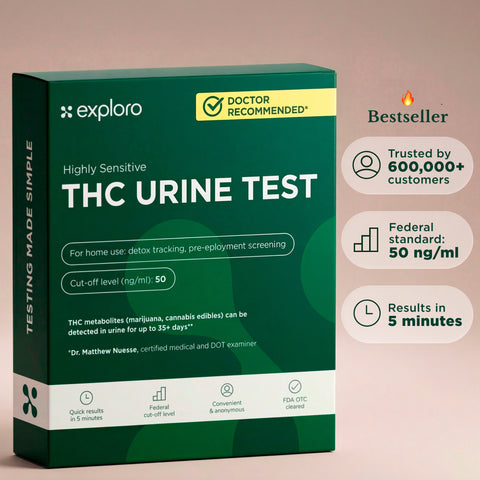 THC Urine Drug Test, 50 ng/mL, 15 StripsReads at 50 ng/mL — the federal screening cutoffThe same cutoff most US workplace urine screens use. Two lines means below the cutoff, one line means above it — and fifteen strips means you can retest as the date gets closer.
$13.49
See details →
THC Urine Drug Test, 50 ng/mL, 15 StripsReads at 50 ng/mL — the federal screening cutoffThe same cutoff most US workplace urine screens use. Two lines means below the cutoff, one line means above it — and fifteen strips means you can retest as the date gets closer.
$13.49
See details →
-
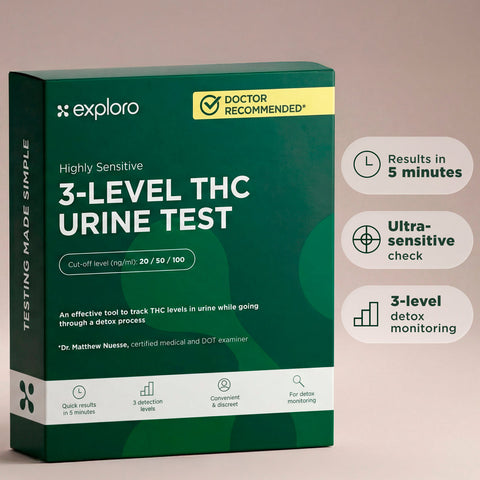 3-Level THC Urine Drug Test, 5 Dip CardsReads at 20, 50 and 100 ng/mLThree cutoff levels on one dip card instead of a single pass-or-fail line, so you can see which way the number is moving rather than only whether you are over it.
$14.99
See details →
3-Level THC Urine Drug Test, 5 Dip CardsReads at 20, 50 and 100 ng/mLThree cutoff levels on one dip card instead of a single pass-or-fail line, so you can see which way the number is moving rather than only whether you are over it.
$14.99
See details →
Exploro makes these tests. Star ratings are from Amazon customer reviews and are refreshed periodically; current prices and full instructions are on each product page.

