
- Federal
- DOT · Federal
- Urine
- Lab confirmation
How Urine Drug Testing Works
Short answer
You provide a sample in a private stall, and the collector checks its temperature and volume in front of you before you both seal it. The laboratory then screens it, confirms anything flagged, and separately checks whether the sample itself is genuine and undiluted. Urine is the standard because the methods are long established and, in federal programmes, it is currently the only usable sample type.
What matters most
- Urine is the only specimen currently usable in federal and DOT programs.
- Temperature and volume are checked in your presence, as genuineness indicators.
- Every federal collection is split into a primary and a second bottle.
- The laboratory also runs validity tests, checking whether the sample was diluted or adulterated.
- Most collections are unobserved; observed collections happen only in defined circumstances.
Jump to section
How the process runs
- Preparation
You empty your pockets, wash your hands, and the collector prepares the collection kit in front of you. Water sources in the area are secured.
- Collection
You provide the sample in a private stall unless an observed collection is required, and hand it straight to the collector.
- Checks in your presence
The collector reads the temperature strip within four minutes and confirms there is sufficient volume, then splits the sample into two bottles.
- Sealing and dispatch
Both bottles are sealed, you initial the seals, you sign the custody form, and the sample goes to a certified laboratory.
What this means for you
Rules differ by state and employer. This section describes federal requirements. Your state law or your employer’s written policy may add rules on top of them.
When the answer changes

Dr. Matthew Nuesse
DOT Certified Medical Examiner
Dr. Matthew Nuesse is a DOT Certified Medical Examiner who reviews Exploro's drug testing guides for medical and procedural accuracy.
Common questions
Can I have the sample tested again?
Yes. Every DOT collection splits your sample into two bottles. If the Medical Review Officer reports a positive, refusal, adulterated or substituted result, you have 72 hours from being told to request that the second bottle be tested at a different certified laboratory. The MRO has to tell you about this right.
Can my employer use a mouth swab for a DOT test?
Not yet. Oral fluid collection is written into the DOT rules, but no laboratory has been certified to analyse those samples, and two are required before any DOT employer may use the method. Until that changes, DOT tests are urine tests.
Is a positive screening result final?
No. A sample that screens positive goes on to a second, more specific confirmatory test, and the result is then reviewed by a Medical Review Officer. The MRO must give you the chance to explain a legitimate medical reason before reporting the result to your employer.
Official sources
Every factual claim above is drawn from these sources. Each was opened and checked on the date shown. Where a rule differs between agencies, the source that governs is named in the text.
-
DOT ODAPC · 49 CFR Part 40 (ODAPC)
49 CFR Part 40 — section navigator and Q&As
View official source ↗ (opens in a new tab) -
eCFR · 49 CFR Part 40 (eCFR)
49 CFR Part 40 — Procedures for Transportation Workplace Drug and Alcohol Testing Programs
View official source ↗ (opens in a new tab) -
DOT ODAPC · DOT — Certified oral fluid labs
HHS Certified Oral Fluid Laboratories
View official source ↗ (opens in a new tab) -
HHS · HHS certified labs (Aug 2026)
Current List of HHS-Certified Laboratories and Instrumented Initial Testing Facilities for Urine and Oral Fluid Drug Testing
View official source ↗ (opens in a new tab) -
Federal Register · DOT final rule (May 2026)
Procedures for Transportation Workplace Drug and Alcohol Testing Programs — final rule (observed urine collections, interim provisions)
View official source ↗ (opens in a new tab)
From Exploro
Test at home
A home test is a screening step. It tells you whether a substance is above or below that test’s cutoff — not how much, and not what a laboratory would report.
-
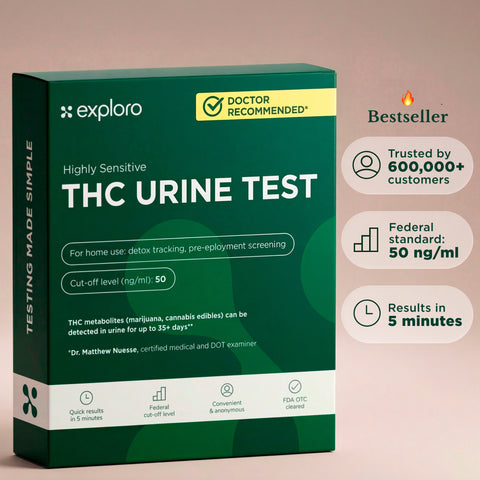 THC Urine Drug Test, 50 ng/mL, 15 StripsReads at 50 ng/mL — the federal screening cutoffThe same cutoff most US workplace urine screens use. Two lines means below the cutoff, one line means above it — and fifteen strips means you can retest as the date gets closer.
$13.49
See details →
THC Urine Drug Test, 50 ng/mL, 15 StripsReads at 50 ng/mL — the federal screening cutoffThe same cutoff most US workplace urine screens use. Two lines means below the cutoff, one line means above it — and fifteen strips means you can retest as the date gets closer.
$13.49
See details →
-
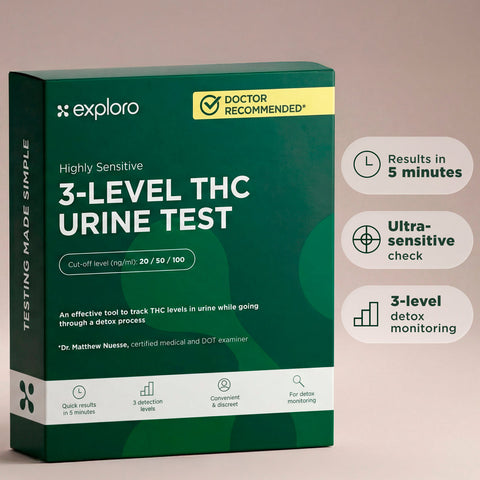 3-Level THC Urine Drug Test, 5 Dip CardsReads at 20, 50 and 100 ng/mLThree cutoff levels on one dip card instead of a single pass-or-fail line, so you can see which way the number is moving rather than only whether you are over it.
$14.99
See details →
3-Level THC Urine Drug Test, 5 Dip CardsReads at 20, 50 and 100 ng/mLThree cutoff levels on one dip card instead of a single pass-or-fail line, so you can see which way the number is moving rather than only whether you are over it.
$14.99
See details →
Exploro makes these tests. Star ratings are from Amazon customer reviews and are refreshed periodically; current prices and full instructions are on each product page.

