
- Federal
- DOT · Federal
- Urine
- Oral fluid
Workplace Drug Testing: The Complete Guide
Short answer
It depends entirely on which program you are in. If your role is federally regulated, the panel, cutoffs, and procedure are set in regulation, and your employer cannot change them. If your employer tests on their own account, they set their own terms, subject to state law. In both cases, you should get an opportunity to explain a legal medication prescription, and your employer is told the outcome rather than your medical details.
What matters most
- There is no single national rule for workplace drug testing. It depends on the program.
- Federally regulated roles follow prescribed panels, cutoffs and procedures.
- An employer testing on its own account largely sets its own terms, within state law.
- Your employer receives the outcome, not your medical history or medication list.
- EEOC guidance says employers should let people explain lawful drug use that may explain a result.
Jump to section
| Federally regulated role | Employer's own programme | |
|---|---|---|
| Who sets the panel | Federal regulation | The employer |
| Who sets the cutoffs | Federal regulation | The employer or its laboratory |
| Confirmatory test | Mandatory | The employer's choice |
| Physician review before reporting | Mandatory | Not guaranteed |
| Split sample you can have retested | Yes | Not guaranteed |
| Grounds for testing | Five defined situations | Set by policy, within state law |
What this means for you
Rules differ by state and employer. This section describes federal requirements. Your state law or your employer’s written policy may add rules on top of them.
When the answer changes

Dr. Matthew Nuesse
DOT Certified Medical Examiner
Dr. Matthew Nuesse is a DOT Certified Medical Examiner who reviews Exploro's drug testing guides for medical and procedural accuracy.
Common questions
Does a positive result mean I am automatically dismissed?
Not under the federal rules. 49 CFR Part 40 governs how you are tested and removed from safety-sensitive duties — it says nothing about your employment. Whether you keep your job depends on your employer's written policy and any collective agreement.
Is a positive screening result final?
No. A sample that screens positive goes on to a second, more specific confirmatory test, and the result is then reviewed by a Medical Review Officer. The MRO must give you the chance to explain a legitimate medical reason before reporting the result to your employer.
What does a cutoff concentration actually mean?
It is the concentration at or above which a laboratory reports a result as positive. Below it, the result is reported negative — even if a trace amount was detected. Cutoffs are a reporting threshold, not a measure of impairment.
Official sources
Every factual claim above is drawn from these sources. Each was opened and checked on the date shown. Where a rule differs between agencies, the source that governs is named in the text.
-
SAMHSA · SAMHSA — Drug-Free Workplace
Drug-Free Workplace Programs
View official source ↗ (opens in a new tab) -
SAMHSA · SAMHSA — Drug testing resources
Workplace Drug Testing Resources
View official source ↗ (opens in a new tab) -
EEOC · EEOC — opioids and employees (2020)
Use of Codeine, Oxycodone, and Other Opioids: Information for Employees
View official source ↗ (opens in a new tab) -
DOT ODAPC · 49 CFR Part 40 (ODAPC)
49 CFR Part 40 — section navigator and Q&As
View official source ↗ (opens in a new tab) -
eCFR · 49 CFR Part 40 (eCFR)
49 CFR Part 40 — Procedures for Transportation Workplace Drug and Alcohol Testing Programs
View official source ↗ (opens in a new tab) -
SAMHSA · SAMHSA — Federal workplace FAQs
Federal Workplace Drug Testing FAQs
View official source ↗ (opens in a new tab)
From Exploro
See where you stand before the test
A home test is a screening step. It tells you whether a substance is above or below that test’s cutoff — not how much, and not what a laboratory would report.
-
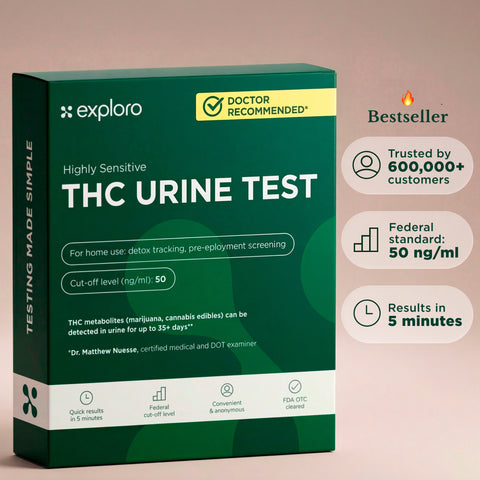 THC Urine Drug Test, 50 ng/mL, 15 StripsReads at 50 ng/mL — the federal screening cutoffThe same cutoff most US workplace urine screens use. Two lines means below the cutoff, one line means above it — and fifteen strips means you can retest as the date gets closer.
$13.49
See details →
THC Urine Drug Test, 50 ng/mL, 15 StripsReads at 50 ng/mL — the federal screening cutoffThe same cutoff most US workplace urine screens use. Two lines means below the cutoff, one line means above it — and fifteen strips means you can retest as the date gets closer.
$13.49
See details →
-
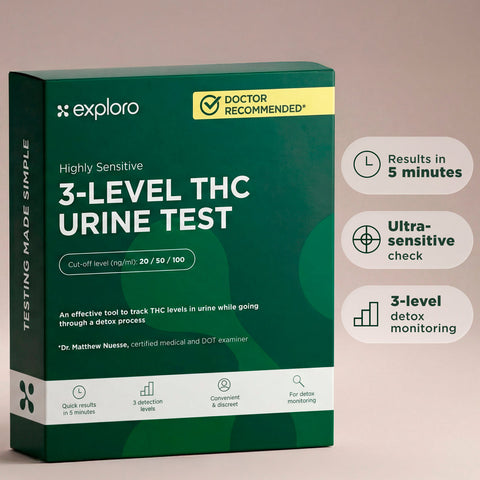 3-Level THC Urine Drug Test, 5 Dip CardsReads at 20, 50 and 100 ng/mLThree cutoff levels on one dip card instead of a single pass-or-fail line, so you can see which way the number is moving rather than only whether you are over it.
$14.99
See details →
3-Level THC Urine Drug Test, 5 Dip CardsReads at 20, 50 and 100 ng/mLThree cutoff levels on one dip card instead of a single pass-or-fail line, so you can see which way the number is moving rather than only whether you are over it.
$14.99
See details →
Exploro makes these tests. Star ratings are from Amazon customer reviews and are refreshed periodically; current prices and full instructions are on each product page.

